
Solar Shades vs Roller Shades for Vancouver Homes
Solar shades vs roller shades for Vancouver homes: compare glare, views, daytime and nighttime privacy, room darkening and motorized control.
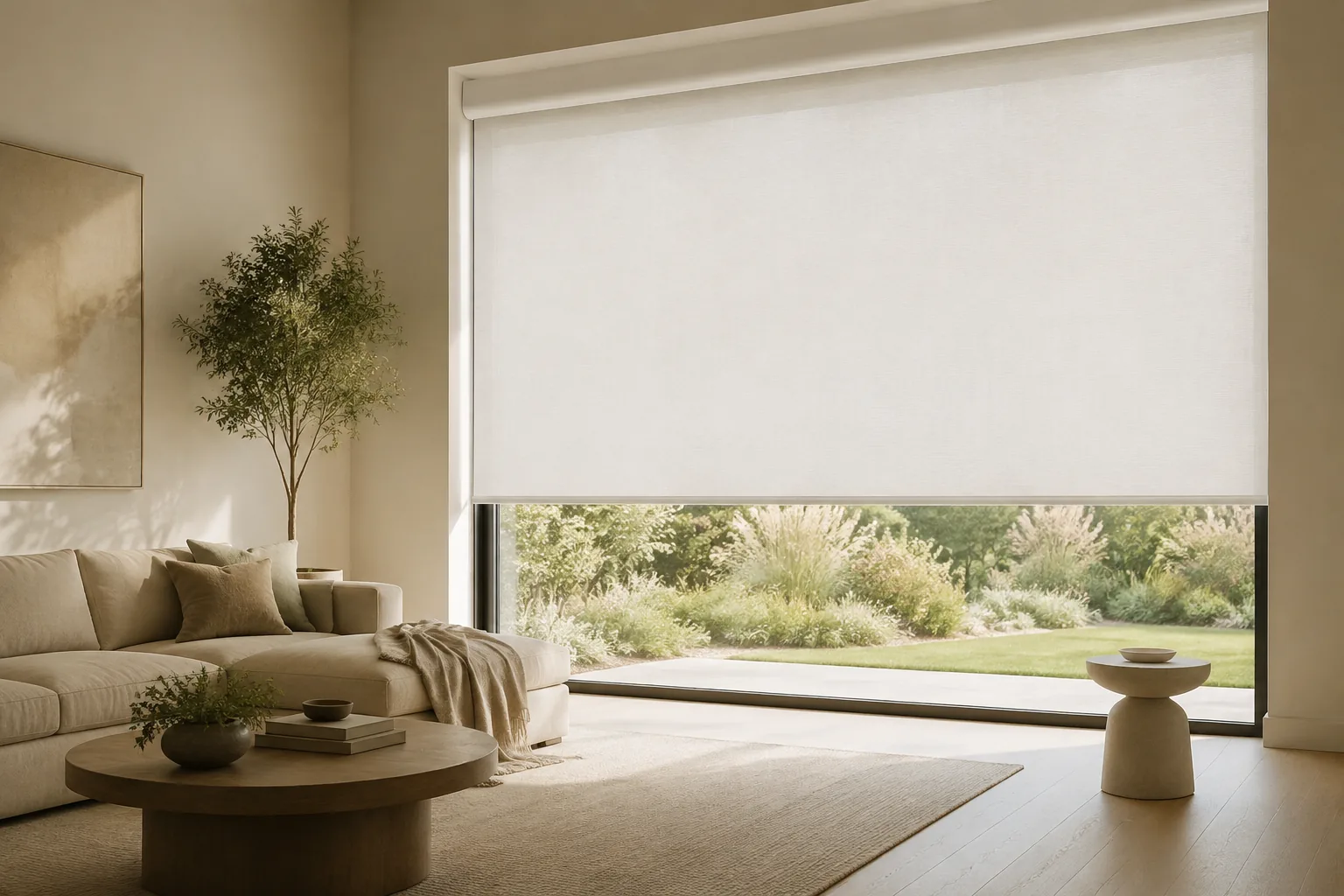
Choose solar shades when daytime glare control and an outward view matter most. Choose light-filtering or blackout roller shades when privacy or room darkening is the priority. Because solar fabric is actually a screen-type roller fabric, the real comparison is between the materials—not two completely different mechanisms.
The simple difference is the fabric
Both styles roll around a tube and can use similar cassettes, brackets and manual or motorized controls. A conventional roller shade uses a sheer, light-filtering, room-darkening or blackout fabric. A solar shade uses a woven screen with small openings that preserve some outward visibility while moderating direct light.
That means a product name alone cannot tell you how dark or private a room will feel. Fabric openness, colour and construction all affect the result. Comparing full-size samples against your window is more useful than choosing from a tiny swatch or an online photograph.
Solar shades vs roller shades at a glance
| Need | Solar screen fabric | Light-filtering or blackout roller fabric |
|---|---|---|
| Outward daytime view | Usually retains some view | Limited or obscured, depending on fabric |
| Screen glare | Designed to soften direct glare | Varies from gentle filtering to full room darkening |
| Daytime privacy | Depends on weave and light conditions | Generally stronger with opaque fabrics |
| Nighttime privacy | Often see-through when interior lights are on | Opaque fabrics provide stronger privacy |
| Bedroom darkness | Not the usual first choice | Blackout fabric is the better starting point |
| Best starting point | Living rooms, offices and sunny views | Bedrooms, bathrooms and privacy-focused rooms |
When solar shades make sense in Vancouver
Solar shades are useful where direct sun makes a screen difficult to read or a seating area uncomfortable, but you do not want to lose the view completely. Large condo windows and west-facing living rooms are common examples. Lowering the shade before the strongest sun reaches the glass is more helpful than waiting until the room already feels bright and hot.
Performance depends on the complete window and fabric, not just an openness percentage. Window direction, glass, shade colour, edge gaps and daily operation all influence comfort. A solar shade can help manage sunlight, but it should not be presented as a replacement for suitable glazing or a complete cooling plan.
What happens on dark, rainy days?
A screen fabric cannot create daylight. On a grey Vancouver afternoon, any lowered covering reduces some of the light reaching the room. If winter brightness is your main concern, choose a fabric with the view and light transmission you prefer and raise the shade fully when glare is not a problem.
This is why we recommend viewing samples in your own windows. A tighter screen that feels comfortable in strong summer sun may not be the fabric you enjoy on an overcast November day. Motorized shades make that seasonal adjustment easy, but manual shades work just as well when you are happy to raise and lower them yourself.
The nighttime privacy question
Solar shades are primarily a daytime sun-control product. When the room is brighter inside than outside, the woven screen may allow people outside to see in. For a street-facing room, bedroom or bathroom, do not assume that a fabric providing daytime privacy will provide the same privacy at night.
An opaque light-filtering roller gives a different balance: it admits diffused light while obscuring the view more effectively. Blackout fabric is intended for substantial room darkening, although light can still pass around the edges unless the window and hardware are designed to reduce those gaps. A double-roller arrangement can combine daytime screen fabric with a separate opaque layer when both functions are needed.
A room-by-room starting point
Living room with a view
Start with solar screen if glare is the problem and preserving some view matters. Add an opaque layer if nighttime privacy is also required.
Home office
Compare solar fabrics against your actual screen position. The goal is comfortable visibility without making the whole room unnecessarily dark.
Bedroom
Start with blackout or room-darkening roller fabric. Consider side channels or a cassette if edge light will disturb sleep.
Bathroom or street-facing room
Prioritize an opaque privacy fabric rather than relying on daytime screen performance.
Manual or motorized control
Manual and motorized versions can use the same fabric families. Motorization is most useful on wide, high or hard-to-reach windows, or when you want a schedule that closes sunny windows before afternoon heat and glare build up. It can also make several shades move together without walking around the room.
For an easy-to-reach bedroom window, a manual shade may be entirely sufficient. Spend on the fabric and fit first, then add motorization where it solves a daily problem rather than assuming every window needs it.
See solar and roller fabrics at your window
Compare glare, view and privacy with real samples during a free in-home consultation. We measure each opening and provide a written quote.